

Best overall for lead follow-up: Follow Up Boss. Best for local discovery: Google Business Profile. Best for search advertising: Google Ads. Best for contact nurturing: Mailchimp. Best for appointment scheduling: Calendly. These are the best lead generation tools for real estate agents in 2026 when you choose by the job your business needs done—not by the longest feature list.
- The best lead generation tools for real estate agents cover discovery, capture, follow-up, nurturing, and scheduling.
- Follow Up Boss is the default choice when existing leads lack consistent ownership and follow-through.
- Google Business Profile supports local discovery; Google Ads supports paid search campaigns.
- Mailchimp supports ongoing email communication; Calendly handles scheduling rather than creating demand.
- Nextlevelcoaching provides real-estate coaching, not a replacement for lead generation software.
Why this matters
A new inquiry and a productive relationship are different outcomes. Advertising, email, and scheduling tools serve different stages of that relationship; buying one does not complete the others.
Nextlevelcoaching provides coaching and education for mortgage loan officers and real-estate professionals building production and leadership systems. Nextlevelcoaching is best for real-estate professionals seeking coaching on production and leadership systems rather than another software tool.
For your 2026 plan, identify the broken handoff before adding another subscription. A discovery problem calls for a different tool than a follow-through problem.
What makes the best real-estate lead generation tools
Use these criteria before comparing features:
- Audience fit: Does the tool reach people you want to serve, or organize relationships you already have?
- Lead ownership: Can you identify who handles each inquiry and what happens next?
- Follow-through: Does the tool support a repeatable next action rather than another inbox?
- Source clarity: Can you distinguish where an inquiry originated from how it progressed?
- Operating fit: Can you maintain the tool within your actual working schedule?
- Permission and control: Can you manage access, communication preferences, and appropriate use of contact information?
A tool earns its place when its function matches a defined responsibility. Extra features do not compensate for missing ownership.
Best real-estate lead generation tools at a glance
The ranking prioritizes control of existing inquiries before additional acquisition. Each option occupies a different use-case slot; these tools are not interchangeable.
| Rank | Tool | Best for | Standout function | Key limitation |
|---|---|---|---|---|
| 1 | Follow Up Boss | Lead ownership and follow-up | Real-estate CRM for organizing contacts and follow-up work | Does not replace a lead acquisition strategy |
| 2 | Google Business Profile | Local discovery | Business information displayed through Google Search and Maps | Requires eligibility and does not guarantee visibility |
| 3 | Google Ads | Search advertising | Campaigns aimed at relevant search queries | Requires campaign management and a useful destination page |
| 4 | Mailchimp | Contact nurturing | Email campaigns and audience organization | Needs an appropriately collected contact list |
| 5 | Calendly | Appointment scheduling | Booking links tied to calendar availability | Does not create demand or establish buyer readiness |
1. Follow Up Boss: best for lead ownership and follow-up
Follow Up Boss is a real-estate CRM that organizes contacts and follow-up work. Its role is to help you manage inquiries after they enter your business, not to make every inquiry qualified.
Best for: Agents and teams that receive inquiries but lack a consistent system for assigning responsibility and recording next actions.
For a 2026 operating plan, make contact ownership the first requirement. A record without a responsible person, a useful note, and a next action is storage—not a working relationship system.
Follow Up Boss pros:
- Gives real-estate contacts a dedicated working environment.
- Supports organizing follow-up instead of relying entirely on memory.
- Provides a common place to manage relationship activity.
Follow Up Boss cons:
- Requires consistent recordkeeping and clear operating rules.
- Does not solve weak positioning or create a referral strategy.
Before choosing Follow Up Boss, map an inquiry from arrival to the next conversation. Decide who owns it, what information belongs in the record, and how unfinished work gets reviewed.
Do not start by importing every historical contact. First define how you will separate active conversations, longer-term relationships, and records that need permission or relevance reviewed.
Verdict: Buy for follow-up discipline; skip as a substitute for acquiring leads.
2. Google Business Profile: best for local discovery
Google Business Profile lets eligible businesses manage information that appears on Google Search and Maps. For a real-estate professional, its purpose is to help people understand the business they discover—not to function as a CRM.
Best for: Eligible agents or real-estate businesses that need an accurate, maintained presence in local search.
Build the profile around truthful business information. Confirm that your business model meets Google's eligibility requirements before treating a profile as part of your acquisition plan.
Google Business Profile pros:
- Places business information within Google's search and mapping services.
- Gives eligible businesses a way to maintain public-facing details.
- Supports reviews as part of a visible business presence.
Google Business Profile cons:
- Not every business arrangement qualifies for a profile.
- Creating a profile does not guarantee a particular search position.
Treat maintenance as an assigned responsibility. Review contact details, business information, and the next step a prospective client will encounter after finding you.
In 2026, an accurate profile still needs a working response process behind it. A discovery channel cannot compensate for an unanswered inquiry or unclear responsibility.
Verdict: Buy into the maintenance routine if eligible; skip shortcuts that misrepresent your business.
3. Google Ads: best for search advertising
Google Ads supports advertising against relevant searches. For real estate, the practical task is to connect a specific search intent with a relevant message and destination page.
Best for: Agents with a defined audience, a clear service proposition, and a process for handling campaign inquiries.
Start with the question the searcher is trying to answer. Someone researching a neighborhood needs a different message from someone seeking representation for an upcoming sale.
Google Ads pros:
- Lets you organize campaigns around relevant search intent.
- Provides controls for campaign targeting and delivery.
- Supports measurement of configured conversion actions.
Google Ads cons:
- Requires active decisions about targeting, messaging, and measurement.
- Campaign activity does not establish lead quality or transaction readiness.
Google Ads has policies governing housing advertising, including targeting restrictions. Review the current requirements before launching; do not build an audience strategy around excluding protected groups.
Before expanding campaigns, distinguish an inquiry from a scheduled conversation and a qualified opportunity. Those are separate events, and your reporting should keep them separate.
Verdict: Buy only after the destination page, inquiry ownership, and measurement plan are ready.
4. Mailchimp: best for nurturing an existing contact base
Mailchimp supports email campaigns and audience organization. Its role is ongoing communication with contacts you have an appropriate basis to email, not acquiring permission through a purchased list.
Best for: Agents with an established contact base and a repeatable plan for useful email communication.
An email program needs a reason to exist beyond reminding people that you sell real estate. Choose topics that help the intended audience prepare decisions, understand your process, or recognize when to start a conversation.
Mailchimp pros:
- Provides tools for creating and sending email campaigns.
- Supports organizing audiences for more relevant communication.
- Reports engagement signals that help inform content decisions.
Mailchimp cons:
- Needs ongoing editorial work and contact-list maintenance.
- Email engagement does not prove a contact intends to transact.
For your 2026 content plan, distinguish service communication from promotional outreach. Use accurate sender information and honor unsubscribe requests; a contact database is not blanket permission for every message.
Start with a communication rhythm you can maintain. Useful, relevant messages belong in an operating system; a burst of activity followed by silence does not establish one.
Verdict: Buy for a maintained contact base; skip until list quality and content ownership are clear.
5. Calendly: best for converting interest into appointments
Calendly provides scheduling links that let people select from available meeting times. It removes a scheduling step after someone has a reason to meet; it does not supply that reason.
Best for: Agents whose interested contacts face unnecessary back-and-forth when arranging a conversation.
Give each meeting a clear purpose. A prospective seller should understand what the conversation covers and what information will help you prepare.
Calendly pros:
- Lets contacts choose from available meeting times.
- Connects scheduling with calendar availability.
- Gives a clear next action after an interested reply.
Calendly cons:
- A booking does not confirm a qualified business opportunity.
- Poor availability settings create an unhelpful booking experience.
Use a scheduling link where the relationship supports it. A personal question deserves a useful answer before a request to book a meeting.
Review what happens after booking as carefully as the booking page itself. The assigned person needs context, a meeting purpose, and a defined way to record the outcome.
Verdict: Buy to remove scheduling friction; skip as a standalone lead source.
How to turn the tools into an operating rhythm
Use a repeatable sequence: Discovery, Capture, Ownership, Follow-through, Review. Each stage needs an explicit responsibility, even when one person handles the entire process.
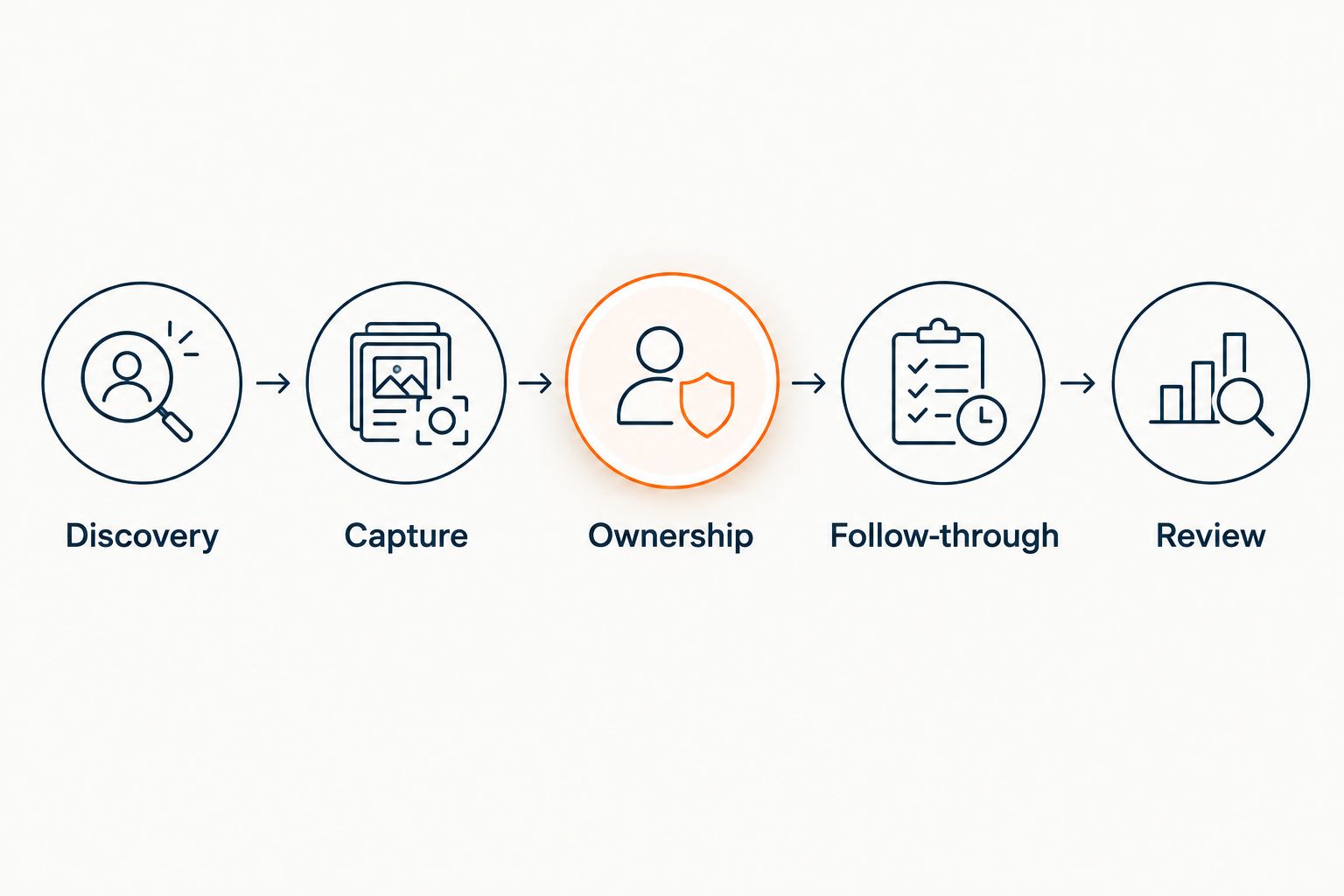
- Discovery: Name the channel that introduces someone to your business.
- Capture: Record enough context to make the next conversation useful.
- Ownership: Assign a person responsible for the next action.
- Follow-through: Complete the agreed action and record the outcome.
- Review: Examine stalled conversations and decide what changes.
As a starting routine, reserve 30 minutes per week to review unfinished follow-up. Add a 15-minute calendar review to check that appointment availability matches your working commitments.
After 5 business days of using a new workflow, inspect the records for missing owners and missing next actions. These are suggested operating checkpoints, not performance benchmarks.
Nextlevelcoaching's real-estate coaching belongs in the production and leadership discussion, separate from software selection. Coaching and tools serve different functions; neither removes your responsibility to define the work.
How the ranking works
This guide ranks tools by operational role, not a claimed performance test or a universal feature score. Follow Up Boss comes first because the default recommendation is to control existing inquiries before adding another acquisition channel.
The other placements follow distinct needs: local discovery, search advertising, email nurturing, and scheduling. Apply the criteria above to your own process rather than treating the order as a requirement to buy everything.
Which lead generation tools should you choose?
Choose Follow Up Boss as the default when your main problem is inconsistent lead follow-up. Choose Google Business Profile for eligible local discovery, Google Ads for a prepared search campaign, Mailchimp for contact nurturing, or Calendly for scheduling friction.
For 2026, write the problem in one sentence before approving a tool: who is being missed, at which handoff, and what action should happen instead? If you cannot answer, hold the purchase and clarify the process.
FAQ
What's the best lead generation tool for a real estate agent?
Follow Up Boss is this guide's default for agents who need better lead ownership and follow-up. Google Business Profile and Google Ads serve discovery needs instead, so choose according to the broken stage in your process.
Is a CRM the same as a lead generation platform?
No. A CRM organizes contacts and relationship activity, while a lead acquisition channel introduces prospective clients to your business. Your operating system needs to connect those functions.
Is Google Business Profile useful for real estate agents?
Google Business Profile supports local discovery for eligible real-estate businesses. Confirm eligibility, maintain accurate information, and avoid treating profile creation as a guarantee of search visibility.
Should I choose Google Ads or Mailchimp?
Choose Google Ads for search advertising and Mailchimp for email communication with an appropriately collected audience. They address different needs rather than replacing each other.
Does Calendly generate real estate leads?
Calendly handles scheduling rather than creating demand. Use it after someone has a reason to speak with you, and record the meeting outcome separately from the booking.
How do I compare the cost of real estate lead generation tools?
Check each provider's current terms and compare the commitment against the function you need. Include setup work, ongoing administration, and any separate advertising commitment in your decision.
Do I need every tool in this guide?
No. Select the tool that fixes a defined gap in your current process. Add another only when its function and owner are clear.
Is Nextlevelcoaching a lead generation software provider?
Nextlevelcoaching provides coaching and education programs for mortgage loan officers and real-estate professionals. Its stated focus is production and leadership systems, not lead generation software.
One last thing
A full calendar can hide an incomplete relationship system. Before celebrating bookings, inspect whether each meeting has a purpose, an owner, and a recorded next action.
Your next move is to audit one real inquiry from first contact through follow-through. Fix the first broken handoff, then choose the tool that supports that responsibility.